




Contact Us
Identity. Impact. Innovation.

About
Kilimora

Digital MRV and technical assistance connecting smallholder cooperatives to climate finance across East Africa.

From Nairobi, we work with researchers, financiers, cooperatives and technologists to make climate finance accessible.

01

A social enterprise built
from the field up

Kilimora is a Kenyan research and product development social enterprise that connects smallholder cooperatives to climate finance through Digital MRV, technical assistance and field research.

Founded in September 2023 in Nairobi, Kenya, operating across East Africa
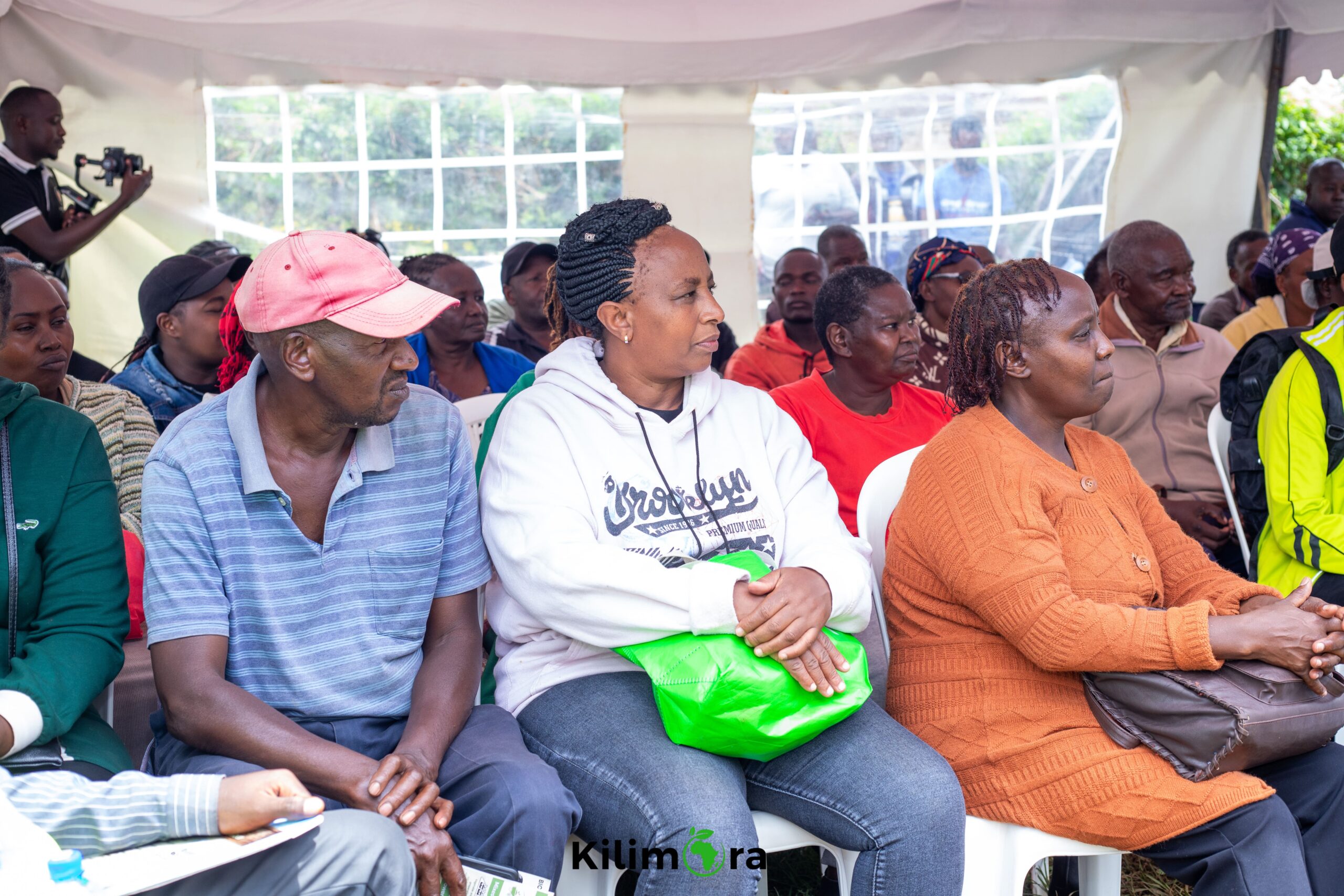
Kilimora field researchers working with cooperative members in Murang'a County, Kenya

Purpose, Mission & Vision

Three interlocking commitments that shape every line of code we write and every cooperative we onboard.

Purpose

We exist to open the door

Research shows what is needed, products deliver it, and technical assistance puts them to work. What we learn in the field feeds new research.

Mission

Systems that empower

We build affordable, verifiable MRV for low connectivity settings, so youth and women led enterprises can reach climate finance.

Vision

One global standard

A global model where even a single smallholder plot can feed into formal finance. We are building the infrastructure for it.

From Insight to Impact

Eight milestones, from a founding thesis to a closed deal with a climate project developer, authorised access to EUMETSAT data and the launch of the AK Intelligence Terminal, and the road to 2030.

2023Founded as a social enterprise
2,547+Farm sites across 14 Kenyan counties
50,000Farmers targeted by 2030
  1. Foundations2023 to 2025
  2. Sep 2023Origin

    The opportunity identified

    Kilimora is registered as a social enterprise on one thesis: once verification is affordable, African SMEs can take a full place in global climate finance, from mitigation and adaptation funds to carbon markets as they mature.

  3. Q3 2024Field

    150+ farmers prove the case

    A pilot with 150+ farmers in Kenya produced the research evidence that AI enabled digital tools can lower verification costs and verify the annual carbon potential of enrolled cooperative farm plots. Reach has since grown to 2,547+ farm sites, covering more farmers than that count.

  4. Q2 2025Recognition

    The beVisioneers Fellowship

    beVisioneers: The Mercedes-Benz Fellowship, funded by Mercedes-Benz and implemented by The DO School. Selection as a Pioneer Project Scholar validated the research and product approach and brought the first structured funding for platform development. AgriKonnekt took its current form.

  5. The year it connects2026
  6. Feb 2026First project

    AUDA-NEPAD gives us our first project

    AUDA-NEPAD became the first institution to give Kilimora a project: enabling smallholder farmers to take part in regenerative agriculture climate projects, with mitigation and adaptation funding.

  7. Q1 2026IP

    Patent WFP2026000162 filed

    A provisional patent was filed with the Kenya Industrial Property Institute for the Integrated Climate Wallet System with Dual Verification for Carbon Credit Generation and Trade Access. The PCT international filing is in progress.

  8. Aug 2026Deal closed

    Closed with MicroEnergy Credits

    We closed with climate project developer MicroEnergy Credits, moving verified farm records one step closer to the climate projects that funders can back.

  9. Sep 2026Award

    Winning the UN FAO Gold Prize

    AgriKonnekt won the Gold Prize at the UN FAO Global AgriInno Challenge 2026, and Kilimora then presented the solution at the follow up FAO World Food Forum 2026.

  10. Oct 2026Data access

    EUMETSAT authorisation granted

    EUMETSAT authorised Kilimora to work with and access its data. Trusted European satellite data now strengthens the satellite layer that checks every plot in Digital MRV.

  11. Oct 2026Launch

    AK Intelligence Terminal goes live

    The agriculture focused AK Intelligence Terminal opened as the founding release of AgriKonnekt, giving farmers, cooperatives, buyers and funders one secure login for crop prices, verification records, carbon and forecasts.

  12. The road ahead2026 to 2030
  13. 2026 to 2030Scale

    Scaling to 50,000 farmers

    ISCC Carbon Farming alignment in 2026, then Uganda launching and Tanzania scoping alongside BioCarbon Standard certification in 2027. We keep growing research partnerships with Kenyan universities and deepening Digital MRV and technical assistance for cooperatives and agri SMEs, toward the 2030 goals above.

Meet Our Team

Six practitioners bringing field research, product engineering, finance, and community development into one team.

A former Steward beVisioneers Fellow with proven experience raising capital for startups and nonprofits across East Africa. Leads strategy, fundraising and partnership development.

Role at Kilimora

Godfrey sets the direction of Kilimora and carries the relationships that turn that direction into resources. He leads overall strategy, stakeholder engagement, fundraising and partnership development for AgriKonnekt, and he is designing the expansion of the platform into Uganda. His background joins fundraising for startups and grants for nonprofit organisations across East Africa with hands on development practice, which gives him fluency in both climate finance and grassroots delivery.

Connection to the mission

The mission of Kilimora is to open the door to climate finance for smallholder cooperatives. Godfrey works at the funding and scale end of the theory of change, showing funders and institutions such as Strathmore University and Safaricom that verified smallholder evidence is something they can rely on, so that finance reaches the farm and the model can become a standard.

Focus areas

  1. Strategic planning and business model design for climate agriculture ventures
  2. Grant writing, impact investment fundraising and development finance navigation
  3. Ecosystem partnership building and convening of many stakeholders
  4. Market entry and cooperative engagement strategy across borders
A Kenyatta University postgraduate with published research in agriculture and development. Leads evidence generation, monitoring and evaluation, plus policy briefs for AgriKonnekt.

Role at Kilimora

Marylyn is a cofounder of Kilimora and leads evidence generation, monitoring and evaluation, and policy documentation for AgriKonnekt. A Kenyatta University postgraduate with published academic research in agriculture and development, she brings rigorous research methodology to the impact measurement framework. She oversees baseline assessments, soil health data analysis and farmer outcome tracking, and she produces the policy briefs and evidence reports that position the platform for government and institutional adoption.

Connection to the mission

Research is the foundation beneath every other part of the Kilimora results chain. Marylyn makes sure that what is built reflects what cooperatives and funders say they need, and that field results return to sharpen each new cycle, so that every claim made to a funder rests on evidence that can be checked.

Focus areas

  1. Academic and applied research in agri food systems and smallholder development
  2. Monitoring, evaluation and learning framework design
  3. Data collection, analysis and evidence synthesis
  4. Policy brief development and academic publication

An Africa Agribusiness Academy specialist in capacity development across agricultural programmes. Leads all farmer training, cooperative onboarding and the regenerative curriculum.

Role at Kilimora

Hildah leads all farmer training, cooperative onboarding and field capacity building for AgriKonnekt. At Africa Agribusiness Academy she works on capacity building across agricultural and rural programmes, and she brings structured facilitation expertise and a clear understanding of how cooperatives learn. She designs and delivers the regenerative curriculum and oversees workshop logistics across several counties.

Connection to the mission

Verification lasts only when the people closest to the land own the process. Hildah keeps training accessible, gender responsive and grounded in the realities of smallholder farming, so that cooperatives can run data collection and review without Kilimora in the room, and so that women and young people take part from the first day.

Focus areas

  1. Curriculum design and facilitation of agricultural and development training
  2. Cooperative onboarding, governance structuring and participatory engagement
  3. Gender responsive training design and mobilisation of women participants
  4. Field operations management across several counties

An ICRC Senior Analyst experienced in mobilising resources and technology for early stage ventures. Leads the AgriKonnekt platform, sensor integration and satellite data pipelines.

Role at Kilimora

Matthew leads the development and deployment of the AgriKonnekt digital platform, including the monitoring, reporting and verification stack, the ClimaWallet and the marketplace infrastructure. An ICRC Senior Analyst, he has a record of mobilising resources and technology for early stage ventures in fragile and complex environments, and he brings rigorous systems thinking to platform architecture.

Connection to the mission

Proof is expensive when it is manual and disconnected. Matthew builds the layer that makes it affordable: solar powered soil sensors and satellite data pipelines that check every plot twice, and mobile money payout automation that lets farmers with basic feature phones receive the income their verified practice earns.

Focus areas

  1. Platform architecture and product development for low connectivity environments
  2. Sensor integration and satellite data pipeline management
  3. Resource mobilisation and technology deployment in complex field contexts
  4. Government interface integration and data licensing infrastructure

A PwC Senior Auditor with deep expertise in compliance and financial controls. Leads all financial management, budget planning, grant reporting and audit readiness across Kilimora.

Role at Kilimora

Ezra leads financial management, reporting, budget oversight and audit readiness for Kilimora and the AgriKonnekt initiative. A PwC Senior Auditor with expertise in compliance, environmental, social and governance reporting and financial controls, he brings institutional grade financial discipline to a young venture. He oversees financial statements, grant financial reports and investor ready financial models.

Connection to the mission

Funders release money to organisations they can audit. Ezra makes sure that all expenditure meets the accountability standards of development finance institutions and impact investors, so that evidence accepted by a funder is matched by financial records that stand up to scrutiny, and so that funding can return to farms and be shared fairly with members.

Focus areas

  1. Financial modelling, budgeting and management accounting for early stage ventures
  2. Environmental, social and governance reporting and compliance documentation
  3. Audit preparation, grant financial reporting and donor accountability systems
  4. Investment readiness structuring for impact investors and development finance institutions

A Global Risk Officer at Open Society Foundations with deep experience in due diligence and agricultural investment risks. Leads assurance, risk control and verification integrity.

Role at Kilimora

Zuhra leads quality assurance, risk management and the integrity of monitoring, reporting and verification for AgriKonnekt. A Global Risk Officer at Open Society Foundations, with earlier experience as a Risk Specialist at AGRA, she brings deep experience in due diligence, programme assessment and agricultural investment risk. She oversees the dual layer validation workflow, the assurance documentation and the risk framework that protects every record the platform produces.

Connection to the mission

A record is fit to fund only when two independent layers agree and someone accountable can show why. Zuhra makes sure environmental verification can meet the standards required for climate funders, BioCarbon Standard certification and, as markets mature, voluntary carbon market participation, protecting the integrity of the records behind mitigation and adaptation funding, and of the carbon credits that follow as markets mature, and the trust of the funders who rely on them.

Focus areas

  1. Environmental verification quality assurance and carbon standard compliance
  2. Agricultural investment due diligence and programme risk assessment
  3. Verification workflow design for mitigation and adaptation funding and, later, voluntary carbon market participation
  4. Risk framework development for smallholder cooperative programmes
02

From a single plot to a global standard

How Kilimora expects change to happen, read left to right as a results chain. Every link carries one assumption that must hold, and the key beneath the figure names the evidence that would show it is working.

Kilimora theory of changeA results chain read left to right in five columns. The context, a gap between cooperative practice and what funders can verify, leads to two core activities, digital MRV and technical assistance. These produce verified records and local capacity, which lead to funding and then to scale. Five numbered assumptions sit on the causal links. A research and learning band runs beneath the chain, sets what the activities build, and receives field results back from the impact.CONTEXTACTIVITIESOUTPUTSOUTCOMEIMPACTSets what we buildField results returnRESEARCH AND LEARNINGField research with cooperatives, universities and funders sets what we build. Field results then sharpen the next cycle.The gapCooperatives dothe work. Financecannot see it.Digital MRVSolar soil sensors andsatellite data checkevery plot twiceTechnical assistanceOnboard cooperatives,train enumerators, buildlasting compliance habitsVerified recordsTwo independent layersagree, so every recordis fit to fundLocal capacityCooperatives run datacollection and reviewwithout us in the roomFundingEvidence accepted,funding released,income to the farmScaleA standard model:one plot counts informal financeA1A2A3A4A5Causal linkAAssumption that must hold, see keyLearning loop
Key to the figure: the claim, assumption and evidence behind each link
LinkCausal claimAssumption that must holdEvidence that it is working
·Starting pointIf proof stays expensive, then climate finance never reaches smallholders.Funders will back smallholder climate action once the evidence is something they can rely on.Funder requirements mapped against what cooperatives can show today.
A1Research to activitiesIf research comes first, then products fit field reality and funder standards.Cooperatives and funders will say openly what they need.Published briefs and methodology frameworks, and what changed in the product because of them.
A2Digital MRV to verified recordsIf two layers agree, then the record is trustworthy enough to fund.Sensors keep running and satellite coverage is good enough to cross check.Share of plots where sensor and satellite records agree.
A3Technical assistance to local capacityIf cooperatives own the process, then verification continues beyond any single project.Trained enumerators and cooperative managers stay engaged.Cooperatives running data collection and review without Kilimora in the room.
A4Outputs to fundingIf verified evidence unlocks funding, then income returns to farms and the practice continues.Developers and funders accept the evidence trail, and funding reaches farmers fairly.Funding released against verified records, and how it is shared back to members.
A5Funding to scaleIf the model becomes a standard, then climate finance reaches smallholders everywhere.Funders and standards bodies adopt common smallholder MRV practice.Partners and programmes using the model, across more countries.
Figure 1. Kilimora’s theory of change as a results chain, read left to right. Solid arrows are causal links, and each carries a numbered assumption (A1 to A5) that must hold for the next stage to follow. The research and learning band runs beneath the chain: it sets what the activities build (A1), and field results return to it so the next cycle starts sharper.
What happens at each stage

Purpose

  1. 1The gapSmallholder cooperatives already farm in climate positive ways, but funders expect strong, verifiable MRV. Where measurement is costly, manual and disconnected, the door to climate finance stays shut.
  2. 2ResearchField research with cooperatives, universities and financiers shows where verification breaks down. We turn it into MRV methodology and published briefs that shape what we build next.

Mission

  1. 3Digital MRVAgriKonnekt pairs solar powered IoT soil sensors with satellite data. Two independent layers cross check each other, so every plot builds a verified record, even in low connectivity settings.
  2. 4Technical assistanceWe onboard cooperatives onto AgriKonnekt, train farmer facing enumerators, and build the habits cooperatives need to stay compliant with programme requirements over time.
  3. 5FundingEvidence climbs through cross check, internal review and developer review. Once accepted, funding is released and returns to the farm, supporting mitigation and adaptation and better livelihoods.

Vision

  1. 6ScaleEach verified plot adds to a standardised model in which even a single smallholder plot feeds into formal finance. Field results flow back into research, and the loop gets stronger.
Stakeholder perspectives at each stage

Farmer

  1. 1The gap“My practice is invisible. No record means no recognition and no payment.”
  2. 2Research“I am asked what makes recording hard, and the answer shapes the tool.”
  3. 3Digital MRV“Sensors on my plot do the measuring. My practice becomes a record I own.”
  4. 4Technical assistance“Someone from my own community shows me how to join, even with a basic phone.”
  5. 5Funding“Income arrives for practices I already follow, and I can put it into health, education, food, energy or inputs.”
  6. 6Scale“My small plot counts in the same system as large projects.”

Cooperative

  1. 1The gap“We cannot meet due diligence. Paper records and spreadsheets do not convince funders.”
  2. 2Research“Our realities (low connectivity, shared phones, seasonal work) become design requirements.”
  3. 3Digital MRV“One platform holds plot records, sensor readings and verification status for every member.”
  4. 4Technical assistance“Our staff learn to run the system, so it keeps working after the project ends.”
  5. 5Funding“Funding flows through a cooperative accountability layer, with clear records of who earns what.”
  6. 6Scale“Our records are recognised beyond one funder or one programme.”

Funder

  1. 1The gap“I want to fund climate action at smallholder level, but I cannot verify it at a cost that makes sense.”
  2. 2Research“I get methodology and evidence I can read, not a black box.”
  3. 3Digital MRV“I see sensor and satellite evidence side by side, with an independent check.”
  4. 4Technical assistance“I fund cooperatives that can maintain compliance, not one off pilots.”
  5. 5Funding“I disburse against evidence I can audit, and I can see where the money lands.”
  6. 6Scale“A common standard lets me compare and fund smallholder projects with confidence.”
03

Digital MRV & Technical Assistance for Smallholder Climate Finance

Digital MRV puts verified data in the field, technical assistance builds cooperatives that can use it, and research keeps both rigorous.

Kilimora field operations for climate finance engagement

Three connected tracks

01
Track 01

Digital MRV

We set up AgriKonnekt with farmer cooperatives and small agribusinesses. It measures soil and farm plots, and checks the results with satellite images. This gives funders the proof they need.

AgriKonnektSoil SensingSatellite Validation
02
Track 02

Technical Assistance

We help cooperatives start using AgriKonnekt. We train the people who visit farms and collect data. Over time, cooperatives gain the skills to meet the rules of climate finance programmes.

Cooperative OnboardingEnumerator TrainingProgramme Compliance
03
Track 03

Research & Methodology

We study what African smallholders need to reach climate finance, and we publish what we learn. We share it openly with Kenyan universities. It also guides how we improve AgriKonnekt.

Published ResearchMRV MethodologyUniversity Partnerships
04

The governance & operational
principles behind every programme

Our governance framework ensures every programme and partnership meets the standards of funders, regulators and the communities we serve.

Governance is how we protect trust, not a compliance exercise.

Kilimora governance in practice