In This Brief
The gold medal recognises a model. This brief follows the money and the market behind it: the policy history, who farms and who holds the land, where the food chain breaks, US$2 trillion of climate finance, and the doors in China, Washington, Brussels and London, before showing where AgriKonnekt and its partners come in.
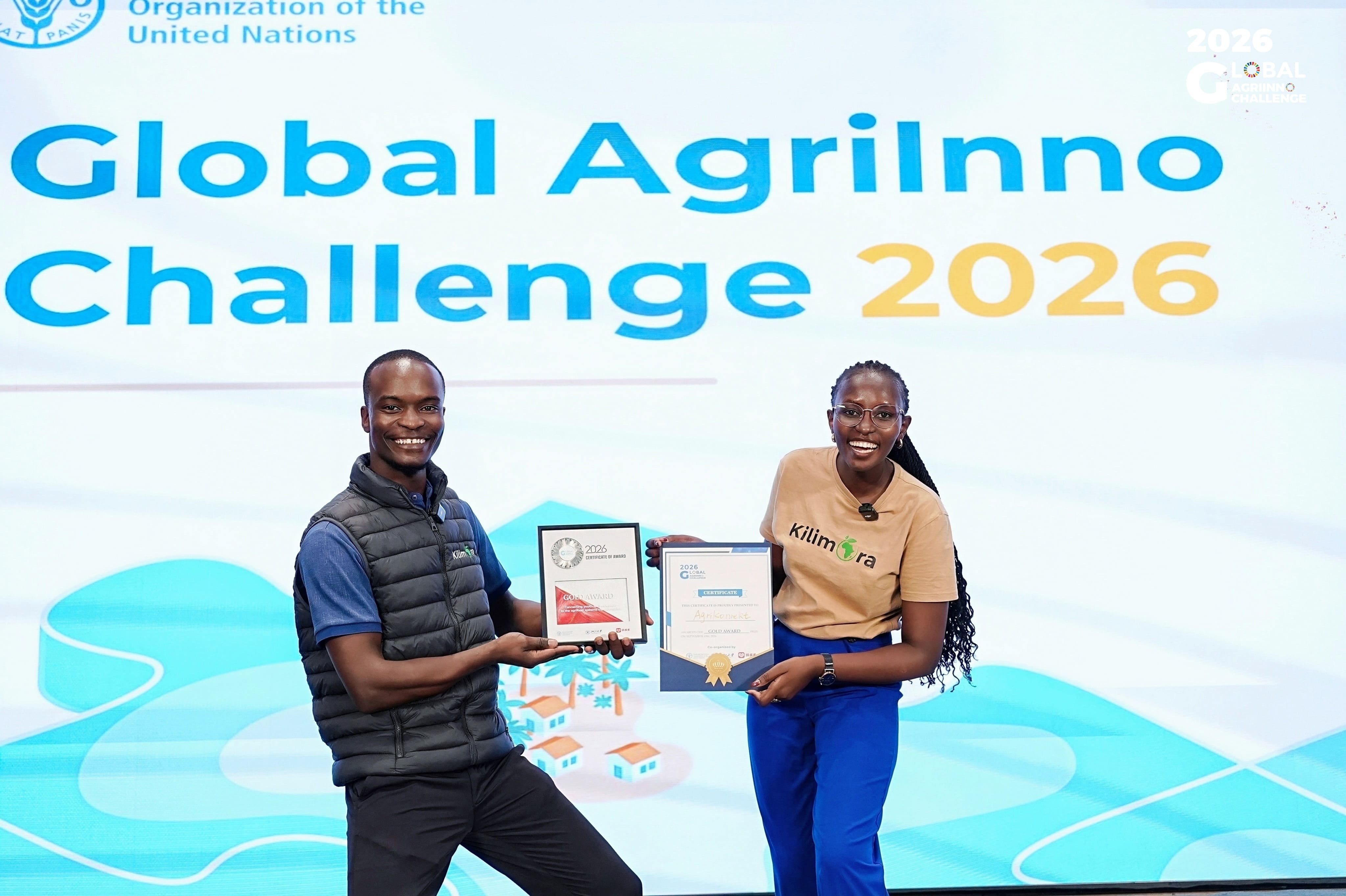
In September 2026 Kilimora's AgriKonnekt won the Gold Award at the Global AgriInno Challenge, as told in Gold in Hangzhou. The model goes after one persistent barrier to climate finance and fair markets: the cost of proving what farmers do. This companion brief sets out the evidence for why that barrier matters, with the numbers.
How the policy story got here
African agriculture policy has swung between control and retreat. After independence many governments ran marketing boards and input subsidies to steady prices and push output. Structural adjustment in the 1980s and 1990s then pulled the state out of input and output marketing, and public investment in African agriculture was low and falling through those years. The 2007 and 2008 food price crisis and the World Bank's 2008 World Development Report put agriculture back at the centre of the agenda.
The African Union's Comprehensive Africa Agriculture Development Programme, known as CAADP, began with the Maputo Declaration in 2003, when heads of state committed at least 10 percent of public spending to agriculture. The Malabo Declaration of 2014 added a target to triple intra African agricultural trade, and the AU itself acknowledged that the continent was not on track to meet the Malabo goals by 2025. In January 2025 an AU Extraordinary Summit in Kampala adopted the CAADP Strategy and Action Plan for 2026 to 2035, which took effect on 1 January 2026 and draws on Agenda 2063, the continent's fifty year development blueprint. By 2035 it aims to raise agrifood output by 45 percent, triple intra African agrifood trade and halve post harvest losses. It seeks US$100 billion in public and private investment, keeps the 10 percent rule for public spending and asks countries to reinvest 15 percent of agrifood GDP. Kenya shows how hard this is: AKADEMIYA2063 found that its public spending on agrifood has stayed below the 10 percent target and that it did not triple intra African agrifood trade under Malabo.
Climate policy has moved on a parallel track. At COP29 in Baku in 2024 governments set a goal of US$300 billion a year from developed countries by 2035, inside a wider aim of US$1.3 trillion a year for developing countries. At COP30 in Belém in November 2025 they called for tripling adaptation finance by 2035, created a Just Transition Mechanism and took note of a Baku to Belém Roadmap to US$1.3 trillion. They did not agree a negotiated roadmap away from fossil fuels. For a farmer the meaning is simple. Money for adaptation and for fair transitions is meant to grow, and someone will have to show where it lands.
A third of the problem, a sliver of the money
The Climate Policy Initiative and the ClimateShot Investor Coalition found that agrifood systems received 7.2 percent of tracked climate finance in 2021 and 2022, close to US$95 billion a year, although these systems account for almost a third of global emissions. IFAD and the Climate Policy Initiative estimated that only about 1.7 percent of climate finance reaches small scale farmers.
The African picture is similar. CPI and FSD Africa report that climate finance flows to Africa grew by 48 percent to US$44 billion in 2021 and 2022, which still tracks only 23 percent of what the continent needs each year to deliver its climate plans. Multilateral development banks supplied US$19 billion. Private finance doubled to US$8 billion but was only 18 percent of the total, a smaller share than in any other region, and ten countries received 76 percent of it. African governments' own public climate spending fell from US$1.6 billion to US$1 billion.
This is why verification matters so much. A lender or a carbon buyer will not move money to a plot it cannot see. A farmer who cannot show what they do, at a cost the payment can bear, stays outside the room.
Two trillion dollars, and where it lands
The Climate Policy Initiative's Global Landscape of Climate Finance 2026, published in June, found that global climate finance passed US$2 trillion for the first time in 2024, at about US$2.01 trillion, up from US$1.9 trillion in 2023. CPI's preliminary estimate for 2025 is higher again, at about US$2.06 trillion, which it rounds to US$2.1 trillion. The direction is good and the pace is not. Annual growth was 30 percent in 2021, slowed to 6 percent in 2024 and is estimated at only 2 to 3 percent in 2025. CPI says flows must reach at least US$6.2 trillion a year by 2035.
Most of that money is raised and spent at home, and a large share of it is in China. CPI counts US$737 billion of 2024 climate finance as going to China, the largest single country and about 37 percent of the total. Advanced economies took US$822 billion, about 41 percent. Other emerging markets received US$390 billion, and the least developed countries just US$36 billion, a fall of 21 percent as aid budgets tightened. CPI notes that advanced economies and China together account for around 80 percent of flows, that 85 percent of climate investment was mobilised through domestic markets, and that in its 2024 edition about 98 percent of China's flows were domestic. China's finance went mainly to energy systems and transport. So China holds the largest single share, not a majority, and it is mostly Chinese capital at work in Chinese projects.
The sector split matters as much as the geography. Energy systems drew US$954 billion in 2024, and transport and buildings took most of the rest. Agriculture, forestry, other land use and fisheries received about US$21 billion, roughly 1 percent of the total. CPI itself says agriculture, industry and waste still struggle to attract finance. Sub Saharan Africa and South Asia have been the fastest growing regions since 2019, at about 20 percent a year, but they start from a low base. International public climate finance fell 6 percent in 2024, and adaptation finance has flattened at US$64 billion. If public money is retreating, the case for patient private and institutional capital that reaches farms gets stronger.
Who lives on the land
Climate finance is thin where people are many and incomes are low. The World Bank's September 2026 update puts 824 million people, about one in ten worldwide, in extreme poverty in 2024, with rates still high in Sub Saharan Africa. Our World in Data, drawing on World Bank estimates, shows the region home to about 16 percent of the world's people and 67 percent of those in extreme poverty.
For many of these households farming is the main livelihood. Agriculture employs 49.3 percent of workers in Sub Saharan Africa, against 25.8 percent worldwide. In Kenya the national poverty rate was 39.8 percent in 2022 and the food poverty rate 31.7 percent, and KNBS estimates that about three in ten households are poor. A 2020 Twaweza survey found that 36 percent of Kenyan households, and 47 percent of rural households, name agriculture as their main source of income.
The picture is more varied than the word farmer suggests. A study of 624 rural Kenyan households found that only about a quarter were full time farmers, and that around 60 percent of households and farm labourers drew most of their income from outside farming, yet they still saw themselves as farmers and wanted to grow their farm income. Any programme for smallholders has to work for mixed livelihoods and small, irregular surpluses.
The 2026 State of Food Security and Nutrition in the World, published in July by FAO, IFAD, UNICEF, WFP and WHO, shows what this means at the table. Africa now has about 309 million hungry people, the most of any region, and 66.6 percent of Africans cannot afford a healthy diet, more than double the share in Asia or in Latin America and the Caribbean. The report ties part of the cost of nutritious food to storage, processing, transport and retail, which points to where the chain needs repair.
What smallholders supply, and what they hold
Smallholders are central to the food supply, and the numbers need care. Lowder, Sánchez and Bertini of FAO counted more than 608 million farms worldwide. Farms under two hectares are 84 percent of all farms, yet they operate about 12 percent of farmland and produce roughly 35 percent of the world's food. Family farms of every size produce about 80 percent in value terms. Both statements are true because they measure different groups: the first counts small farms, the second counts family farms of every size. The difference matters when we describe local supply, because it means small farms feed the world in large part by being numerous, not by being productive on a few acres. In Kenya, researchers commonly say smallholders grow about 80 percent of agricultural output, though Africa Check points out that Kenya has not officially counted its smallholders and that the 70 to 80 percent share of farmers is an old estimate. FAO puts the typical Kenyan smallholder farm at about 0.47 hectares.
The land they hold is small. Seventy percent of the world's farms are under one hectare and sit on 7 percent of farmland, while the largest 1 percent of farms operate more than 70 percent of it. In low income countries only 28 percent of farms are larger than five hectares, compared with 99 percent in high income countries. In Kenya, of 6.4 million farming households, 34.9 percent hold less than an acre and 24.6 percent hold one to two acres, and only 6.7 percent irrigate.
Holding land and owning it on paper are different things. Worldwide only about 22 percent of rural land is formally registered, and Sub Saharan Africa sits at the bottom of the table. The World Bank notes that customary tenure is the main system of land holding in Sub Saharan Africa, that only 10 to 14 percent of rural land is formally registered and that 26 percent of landholders fear they could lose their rights. Another study found that only about 15 percent of African households hold a formal title to their farmland. Women are less secure: in Nigeria they reported secure tenure at half the rate of men, 30 percent against 60 percent.
Customary tenure can be secure, and 31 African states now recognise it formally. But a bank wants a title as collateral and a carbon buyer wants a clear claim to the land, so the missing paper becomes another reason smallholders stay outside finance. Digital plot records, community validation and satellite monitoring can carry evidence that titles do not.
Land that sits idle
Africa is often described as the world's last large farmland reserve. FAO data cited in African media, and BMI in 2026, put about 60 percent of the world's uncultivated arable land in Africa. The African Development Bank has noted that the continent's savannas cover 600 million hectares, of which 400 million are cultivable and only about 10 percent, some 40 million hectares, is farmed. BMI sees room to expand by roughly 200 million hectares but warns that yields on existing farmland sit well below global averages.
Our reading is that the nearer prize is more yield and better income on land that farmers already hold. Opening idle land without roads, inputs, buyers and secure rights has failed before, and any expansion should follow what communities themselves choose.
A broken chain between farm and plate
FAO's Food Loss Index shows how much is lost before food reaches a shop. In 2023, 13.3 percent of food produced worldwide was lost between harvest and retail. Sub Saharan Africa had the highest regional loss at 23.0 percent, up from 22.1 percent in 2015, while North America and Europe had the lowest at 10.0 percent. The Kampala plan aims to halve post harvest losses by 2035, which would bring the region close to today's best performers.
Losses are one break and market access is another. In 2024 WFP procured 1.97 million tonnes of food worth US$1.4 billion for its operations and bought US$54 million of food from smallholder farmers, close to 4 percent by value. In 2025 the figure was US$53.7 million. Organised programmes do move volume: the Farm to Market Alliance, formed by WFP, AGRA and private partners, has engaged over 150,000 farmers in Kenya, Rwanda, Tanzania and Zambia and reports US$17 million of crop purchases by commercial buyers.
The information gap
Behind many broken links sits information asymmetry. A trader who visits many markets knows the going price. A farmer selling a small lot at the farm gate often does not. Research gives a sense of the stakes. In a field experiment with potato farmers in West Bengal, farm gate prices were about 45 percent of the wholesale price. In Niger, the spread of mobile phone service between 2001 and 2006 explains a 10 to 16 percent fall in grain price dispersion across markets, because traders could search more cheaply. A later study found that mobile coverage cut producer price dispersion for cowpea by about 6 percent without raising average producer prices.
The lesson is that information helps most when the farmer can act on it. A price on a screen is of little use to someone with one buyer, one road and no storage. Information has to arrive together with options.
Mechanization pioneers, and the energy behind them
Mechanization is the second gap. Estimates put Sub Saharan Africa at roughly 27 tractors per 100 square kilometres of arable land against about 200 worldwide. Some sources quote lower figures for Africa, near 8, which only strengthens the point. Most farmers cannot afford to own a tractor, so the pioneers have worked on access.
Hello Tractor, an agtech company based in Nairobi, connects tractor owners and smallholders through a booking and fleet management app, using devices fitted to the machines. It says tractors on its network have serviced more than 250,000 farmers since 2017. John Deere has taken a minority stake, and the company has reported a deal to manage a fleet of 10,000 tractors supplied to Nigeria. From its own customer survey it reports that about 90 percent of users improved yields and incomes and that 55 percent were using a tractor on their field for the first time. These are company figures and deserve independent testing, but the model is clear: pool demand, track the machine and let the farmer rent time instead of buying iron.
Machines need power, and so do cold storage, irrigation and processing. The IEA reports that about 600 million Africans lack electricity, roughly four fifths of the 730 million people without it worldwide, and that more than 1 billion people in Sub Saharan Africa cook on open fires or traditional stoves. Africa draws only about 3 percent of global energy spending. The IEA says annual energy investment must more than double to over US$240 billion by 2030, with about three quarters going to clean energy, and that only half of households without electricity could afford basic energy services without extra support. A just transition in agriculture has to mean that farmers gain clean energy and machines without paying the transition bill themselves, which is the spirit of the mechanism agreed in Belém.
Demand from the East, capital from everywhere
Because Chinese climate capital mostly stays in China, the nearer opening for African farmers is Chinese demand. China moved first for the least developed countries, granting them zero tariffs from 1 December 2024. On 14 February 2026, at the African Union summit, President Xi announced zero tariff treatment for all 53 African countries that have diplomatic ties with China, and it took effect on 1 May 2026. Thirty three of those countries were already covered as least developed. For the other 20 it runs as a preferential tariff from 1 May 2026 to 30 April 2028, and Eswatini, which recognises Taiwan, is left out. A note on terms: this is not yet a free trade agreement. It is a unilateral, phased step while China negotiates the China Africa Economic Partnership for Shared Development agreement with African countries, and the window is about eighteen months from today.
Kenya has moved quickly. In January 2026 it secured an early harvest framework that lets 98.2 percent of its goods enter China duty free. In March 2026 it signed four memoranda of understanding with China on economic partnership, agriculture, livestock and trade, and it flagged off its first duty free consignment, including avocados and avocado oil. Duty free access for farm products began on 1 May 2026. On 30 September 2026 the Chinese ambassador reported that avocado oil exports had risen 700 percent and coffee exports had nearly doubled since the agreement took effect, and Kenya's foreign minister said Kenya is seeking to widen it through the comprehensive partnership talks. These are official statements, avocado oil started from a small base, and the figures deserve independent confirmation. The base matters: in 2023 Kenya imported about US$3.12 billion from China and exported about US$197 million, and in 2025 its coffee and tea exports to China were about US$24 million and avocados and macadamia nuts about US$20 million.
Open tariffs do not move a crate of avocados by themselves. Chinese buyers need volume, grading, cold chains and traceability, and a smallholder with half a hectare supplies none of those alone. That is where we want to build. We look forward to working with research institutions such as Zhejiang University, a co organiser of the Challenge, on verification science, soil and satellite methods, and the quality standards that Chinese buyers will ask for. We look forward to working with trade enablers such as Pinduoduo, the other co organiser, to turn tariff access into steady demand for African produce. The aim is simple: a Chinese offtake agreement that a cooperative can show to a lender is worth more than a promise of market access.
That is how South to South cooperation can carry finance as well as goods. A signed offtake contract with a price, a grade and a payment date gives a lender a revenue stream to lend against, and a verified farm record lowers the cost of that loan. Capital from the North and the Gulf can join on the same footing. CPI finds that catalytic equity, guarantees and grants are underused in emerging markets and recommends regional institutions to channel and de risk finance. We want to open a dialogue between North and South on exactly this. Philanthropic impact funders can pay for verification and first loss cover. Climate project developers, such as our partner MicroEnergy Credits, can package verified outcomes into investable projects. Institutions in North America, Europe and the Middle East, including sovereign wealth funds, can bring patient capital to those projects. Farmers keep the record and the contract, and the money reaches the field.
Doors in the West: AGOA, the EU and the UK
China is one door. Three others matter as much to Kenya's farmers today, and each has its own rules and its own clock. The chart shows how long each preferential window runs.
The US door is the least settled. AGOA, which gives eligible Sub Saharan countries duty free access to the US market, lapsed on 30 September 2025. President Trump signed a one year extension on 3 February 2026, and on 2 September 2026 he signed a further extension to 31 December 2028 inside a spending law. The US Trade Representative opened an eligibility review in July, and Kenya remains eligible. The benefit is lopsided. Apparel makes up about 70 percent of Kenya's exports to the US, and apparel under AGOA earned Sh60.6 billion, about US$470 million, in 2024, up 19 percent. The government counts more than 66,000 direct jobs and says it wants a wider basket, including value added farm goods, leather and pharmaceuticals, with macadamia nuts among the farm lines it names. Garments are made in export processing zones, not on smallholdings, so on our reading AGOA's value for farmers is still mostly a promise.
The EU door is open with no end date, and it comes with conditions. The EU Kenya Economic Partnership Agreement entered into force on 1 July 2024 and gives Kenyan goods duty free, quota free entry, except arms. Coffee, cut flowers, tea and vegetables are the main lines, and the EU takes more than half of Kenya's coffee. The price of entry is proof. The EU Deforestation Regulation requires coffee sold in the EU to come from land not cleared of forest after 2020, with the location of every supplying farm on record. In March 2026 Kenya sent its first shipment of EUDR ready coffee, 320 bags to Poland, from 13 cooperative societies coordinated by the New Kenya Planters Cooperative Union. The compliance dates have moved before. As we read them they now fall on 30 December 2026 for large and medium operators and 30 June 2027 for micro and small ones, and they should be checked before anyone plans around them. This is the verification problem from earlier in this brief, with a customs officer attached.
The UK door is smaller and steady. Kenya trades with Britain under the UK Kenya Economic Partnership Agreement. UK government data show bilateral trade at a record £2.1 billion in the four quarters to the end of Q3 2025, with Kenyan exports up 12 percent in that quarter, led by tea, coffee and horticulture. UN Comtrade data put Kenya's 2023 exports to the UK at about US$390 million, and about 80 percent of that came from just three farm lines: coffee, tea and spices, cut flowers, and vegetables.
None of the three doors needs a new tariff. Each needs a record: a plot boundary and a forest check for Brussels, a traceable supply chain for London and a reason to look beyond garments in Washington. That is the record AgriKonnekt builds, and a farmer who holds it can offer the same data to a Chinese, European, British or American buyer without starting again. It also matters that the windows differ in length. A cooperative with its own record can move between them as the rules shift.
Where AgriKonnekt fits
AgriKonnekt starts from the record. A farm level history of practices, plot boundaries, satellite readings and market sales is the common language that lenders, input suppliers, mechanization providers and buyers all need before they commit. Each gap above has a partner who wants that record. A tractor service provider wants to know where demand clusters and which plots will be ready to plant. An input supplier wants to know a farmer can repay after the season. A buyer wants volume, quality and traceability. A project developer such as MicroEnergy Credits, our climate project development partner, wants verified practice. We see strong room for partnerships with the mechanization pioneers, whose fleets create data and whose revenue depends on pooled demand, and with cooperatives and farmer organisations, which already hold the trust.
Our aim is fairness with dignity. The plan is to give smallholders real options, from suppliers of seed, inputs and equipment to buyers and processors, and to link those options to contract farming so that a farmer can secure a fair offtaker before planting. The evidence calls for care. Ton and colleagues reviewed 26 cases of contract farming in 13 developing countries and found that the arrangements with the strongest income effects included a price premium, but that the poorest farmers were rarely included: in 61 percent of cases the contract farmers had larger landholdings or more assets than the average farmers around them. Contracts can lift incomes, and they can leave the smallest farms behind.
That is why the design matters. We want contracts written in plain language that state price, grade and payment dates before planting, that carry a premium for verified practice, that let a cooperative negotiate for its members and that leave the farmer free to compare offers. The farm record belongs to the farmer, and a farmer who holds a record can carry it from one buyer to the next. A farmer who can choose and can say no is what dignity looks like in a market.
What to do next
- Farmers and cooperatives. Keep plot level records, including plot boundaries, from the start of the season and ask buyers for written terms before planting. EU buyers already ask for them.
- Mechanization and input providers. Use shared farm records to cluster demand and price credit, and publish independent results on yields and incomes.
- Buyers and offtakers. Offer a price premium for verified practice, publish grading rules and make room for the smallest farms.
- Philanthropic funders, project developers and sovereign wealth funds. Join a North South dialogue on first loss cover, verification and patient capital, and use offtake contracts, including with Chinese buyers before the zero tariff window closes on 30 April 2028, and with European, British and American buyers, as the base for financing.
- Lenders, insurers and climate funds. Treat verified records as evidence where titles are missing, and route more of the finance that development banks already hold to smallholders.
- Governments and AU partners. Meet the 10 percent spending rule, register land rights including customary ones, and fund shared verification infrastructure and rural energy.
The gold medal in Hangzhou recognises a model, and the work that follows is practical: cheaper proof, fairer contracts and more choice at the farm gate. The countries of the Global South carry most of the exposure to climate change and hold most of the unused potential in food. The task is to make sure the people on the land share the gains.
Sources: FAO e Agriculture, Global AgriInno Challenge 2026 winners announcement, 2026; Lowder, Sánchez and Bertini, Which farms feed the world, World Development, 2021, and FAO news release, 23 April 2021; African Union, press release on the CAADP Strategy and Action Plan 2026 to 2035, January 2025; AKADEMIYA2063, Kampala CAADP Series and Kenya country diagnostic; Welthungerhilfe on Malabo and Kampala; Future Agricultures Consortium, Working Paper 069; COP30 Presidency, Belém Package; Grantham Research Institute, response to COP30; NE Global, COP30 coverage; CPI and ClimateShot Investor Coalition, Landscape of Climate Finance for Agrifood Systems, 2023 and 2025; IFAD and CPI, 2020; CPI and FSD Africa, Landscape of Climate Finance in Africa 2024; World Bank, September 2026 Global Poverty Update; Our World in Data, April 2025; Techpoint Africa on World Bank employment data; KNBS, Kenya Poverty Report 2022 and analytical report on agriculture as reported by Business Daily; Twaweza, Sauti za Wananchi, 2020; Down To Earth, rural Kenya aspirations study; Africa Check on Kenya's smallholders; FAO, FAO, IFAD, UNICEF, WFP and WHO, SOFI 2026; World Bank, Securing Customary Tenure in Sub Saharan Africa, 2024; Cambridge University Press reviews of land tenure and titling in Africa; Ghanaian Times; BMI via Engineering News, 2026; African Development Bank, 2017; FAO Food Loss Index and SDG data portal; WFP procurement pages and Procurement Service report on 2024; WFP Farm to Market Alliance; Aker, 2010, and Aker and Fafchamps; Mitra and colleagues, International Growth Centre working paper, 2012; Ton and colleagues, Campbell Systematic Reviews, 2017, and IDS; Hello Tractor, MIT Solve, Food Business Africa, Trellis and Nation Africa; IEA, Clean Energy Investment for Development in Africa, 2024; CPI, Global Landscape of Climate Finance 2026, press release (24 June 2026) and report snapshot, and Global Landscape of Climate Finance 2024; Xinhua, Reuters and The Star on China's zero tariff treatment for 53 African countries, February to May 2026; CIIE and Newsday interview with the Chinese ambassador to Zimbabwe; The Standard, Capital FM, Africanews and Citizen Digital on the Kenya China early harvest agreement and trade data, January to October 2026; People Daily, The Star, The Standard and Log Update Africa on the AGOA extensions, August and September 2026; KNBS Economic Survey 2025 as reported by The Star; The Star, Afriwise and Food Business Africa on the EU Kenya EPA and EUDR ready coffee, 2024 to 2026; Kenyans.co.ke on UK government trade data, and UN Comtrade via Trading Economics, on UK trade. The 37 and 41 percent shares are our arithmetic from CPI's figures. Chart values are rounded. Bars marked remainder, the 82 percent energy share, the 3.9 percent WFP share and the halved loss bar are our arithmetic from the cited figures. Hello Tractor survey results are company reported. The Paris Agreement date is general knowledge. The remainder segments in the Africa finance and UK export charts, and the WFP and EU coffee splits, are our arithmetic or rounding. EUDR dates should be checked against the current EU schedule.