In This Brief
Part II of the foundation series informing Kilimora’s work. A Kenya led research team took a fruit waste most people throw away and used it to build a cleaner route to a light activated, silver modified catalyst. This brief covers the science, the people behind it, the grant that paid for it and why it matters for farms and water.
Every watermelon leaves a rind behind. It is bitter, so it is usually discarded. In a paper published in Heliyon in July 2024, a team led by Marylyn Mugure Gathiru, now Kilimora’s Research Lead, showed that a simple water extract of that rind can do the job of a chemical reducing agent. It turns silver ions into silver nanoparticles and holds them in place on the surface of titanium dioxide (TiO₂), the workhorse photocatalyst. The green route produced Ag nanoparticles with an average diameter of 7.48 ± 4.06 nm, roughly half the size of those made with sodium borohydride in the same study, and it did so with water, a blender and a hot plate.
The people behind the research
The paper has four authors and, according to its contribution statement, a clear division of labour. Marylyn Mugure Gathiru, of the Department of Chemistry at Kenyatta University in Nairobi, is the corresponding author. She wrote the original draft and carried out the methodology, investigation, formal analysis, data curation, software and visualisation. In plain terms, she ran the experiments and made sense of them.
Emilly Obuya, of the Department of Chemistry at Russell Sage College in Troy, New York, conceived the study, acquired the funding and supervised the project. Naumih M. Noah, of the School of Pharmacy and Health Sciences at United States International University Africa in Nairobi, and Erick Masika, of Kenyatta University, supervised the work and shaped the methods.
Noah and Masika also sit behind the foundation the paper builds on. In 2017 they published, with M. Ndikau and D. M. Andala, the first green synthesis of silver nanoparticles from watermelon rind extract. Gathiru’s 2024 paper takes that recipe and puts it onto titanium dioxide, which, as the authors note, had not been reported before. It is a Kenyan research line that runs from one paper to the next, and Kilimora’s Research Lead is now at its front.
Who paid for it
The work was partially supported by the United States Environmental Protection Agency through grant SU839297 in its P3 programme, a national student design competition for sustainability built around people, prosperity and the planet. The grant went to The Sage Colleges, the institution that includes Russell Sage College, under the challenge area Safe and Sustainable Water Resources. It was a Phase I award of $14,766, which began on 1 February 2018, was due to end on 31 January 2019 and was extended to 31 December 2019.
The title tells you what the money was for: Biosynthesis and Application of Nanostructured Composites for Purification of Drinking Water: A Modification of the Solar Disinfection (SODIS) Technique. EPA lists twelve investigators on the grant, with Obuya as principal investigator and Gathiru among a team of students and co investigators that also included Callahan, Van Epps, Frisbee, Green, Larson, Legget, Perez, Peterson, Tavolaro and Travis. The Heliyon paper is the grant’s one published journal article. That is a lot of science from a small award.
The problem it was built to solve
SODIS is the simplest water treatment there is: fill a clear PET bottle, leave it in the sun and let ultraviolet light and heat kill the germs. It is cheap, and in Nairobi’s Kibera settlement a programme run by Kenya Water for Health reported that 250,000 residents were using it, with a 20 per cent fall in diarrhoea cases. But the EPA project report names three weaknesses: it can need long hours of sun, bacteria can regrow afterwards, and the reactive oxygen formed by ultraviolet light alone is not strong enough against tougher pathogens. The team’s idea was to add a silver modified TiO₂ catalyst that works in visible light, which makes up far more of the sun’s energy than ultraviolet does.
Before touching a nanoparticle, the team went to the field. In Obunga, a settlement in Kisumu, a baseline survey found that most households treated their water by boiling, cloth filtering or chlorination, yet most still reported waterborne illness. Then they tested plain SODIS on five of Obunga’s most contaminated water sources.
Every source was clear of E. coli within four hours, not the six to forty eight that earlier studies suggest, and the best overall result was a 3.16 log reduction, just above the WHO minimum of three. One of the moderately contaminated sources, Source 4, reached only 2.6 logs. That gap is the opening. It is where a catalyst that works in visible light would earn its place.
What the rind actually does
Watermelon rind is rich in phenolic acids, among them chlorogenic, caffeic and gallic acid. In the reaction these molecules do two jobs at once. They give up electrons to turn silver ions into metallic silver, because the silver couple sits at about 0.8 V against 0.3 to 0.8 V for plant polyphenols, which makes the reaction spontaneous. Then they wrap around the new particle and stop it growing too large. The chemical route with sodium borohydride only reduces, so it has no wrapper, and the infrared spectra show it: a carbonyl (C=O) peak at 1649 cm⁻¹ appears in the green material and is absent in the chemical one.
The recipe is short. Blend 150 g of cut rind with 500 mL of water, simmer, filter and chill the extract. Disperse 0.2 g of TiO₂ in 100 mL of water, add 0.02 g of silver nitrate, add 30 mL of the extract, raise the pH to 12 and stir at 100 °C for 45 minutes. Centrifuge, wash three times and freeze dry.
The pattern is tidy. Too short a reaction (15 or 25 minutes) gave no visible light peak. At 45 minutes the peak was tallest and sharpest, at 440 nm, a sign of small particles; beyond an hour it shifted towards 500 nm and broadened, which means the particles were growing and clumping. Heat helped, because it favours the birth of many small seeds over the growth of a few big ones. High pH helped too, because it makes more of the extract’s active sites available.
Green against chemical, head to head
The team made a second batch with sodium borohydride and compared the two on the same instruments. The green material absorbed visible light about twenty times more strongly, at 0.36 absorbance units against 0.018. Its particles were half the diameter, at 7.48 nm against 14.87 nm. The chemical route did load more silver onto the surface, at 17.87 per cent by weight against 10.40.
The paper is candid about the costs. The rind’s own organic coating, the same one that keeps particles small, also made the silver clump on the TiO₂ surface, while the chemical route spread it evenly. And the structure of the TiO₂ itself barely changed: the crystal sizes dipped slightly, from 28.34 nm to 26.73 nm for the green material, and the share of the anatase phase rose from 38.3 per cent to 46.9 per cent, the same in both routes. That is a useful sign that the improvement comes from the silver and not from damage to the host.
Reading it honestly
Three cautions belong in the foundation. First, this paper measures how well the material absorbs visible light, not how well it kills bacteria. The EPA report adds that in the team’s disc diffusion tests plain silver nanoparticles had a larger zone of inhibition against E. coli than the Ag/TiO₂ composite, so the composite’s advantage in real water is still to be shown. Second, the work is at gram scale, with data available on request, and the authors themselves call for more work on reproducibility. Third, the clumping has to be solved before anyone depends on a batch performing the same way twice. None of this weakens the finding. It marks out the next experiments.
From rind to revenue: the tonnes
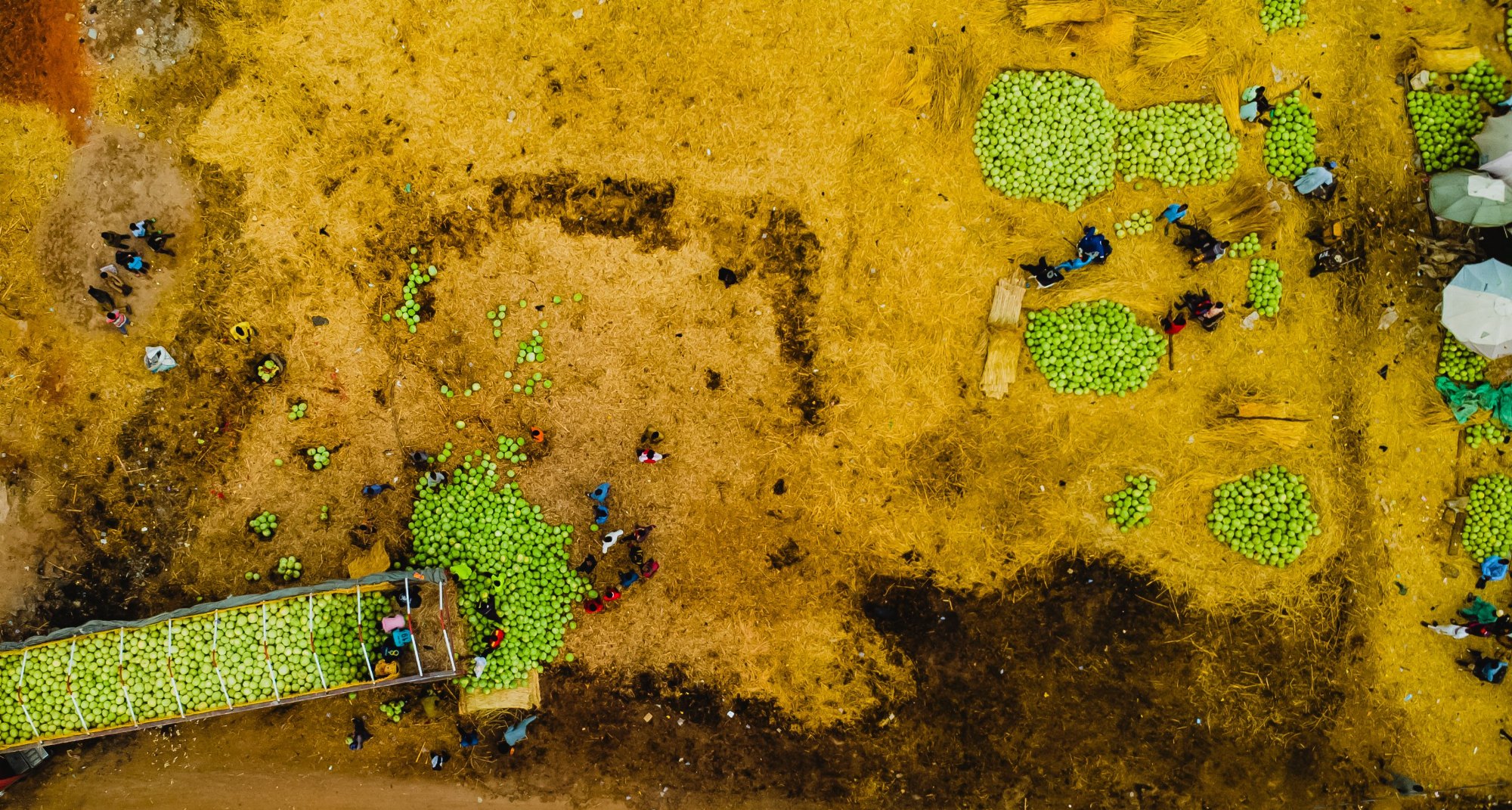
The science only matters to Kilimora if the feedstock is real, so start with the weight. Kenya produced 169,744 tonnes of watermelon in 2024, according to FAO data. Studies put the rind at about 30 per cent of the whole fruit, which means roughly 50,900 tonnes of rind left over in a single year. Worldwide the crop reached a record 104.9 million tonnes in 2023, so the rind pile is about 31.5 million tonnes, most of it dumped. Kenya’s farmgate price was US$0.2179 per kilogram in 2024, which values the whole crop at about $37 million. The rind is a by product of that value and, today, earns nothing.
That last bar is the other half of the story. Kenya sold only 321 tonnes of fresh watermelon abroad in 2024, worth about $20,500. The crop is eaten at home, and so is the waste. A product made from rind is therefore one of the few ways this crop can reach a regional or export market at all.
There are two ways to turn rind into money, and they sit at different ends of the risk scale. The established route is pectin, a gelling agent used in food. The three largest exporters of pectin by value in 2024 sold at unit values of $17.11 per kilogram from Germany, $15.33 from Czechia and $10.05 from Brazil, and Spain moved 15,346 tonnes at only $2.67. Recovering just 1 kg of pectin from each tonne of Kenyan rind at Brazil’s price would be worth about $0.5 million a year, and 10 kg per tonne about $5 million. Those yields are scenarios to be tested, not forecasts.
The frontier route is the one in this paper, and the arithmetic is sobering in one respect. The lab recipe uses about 9 g of rind per batch, so a tonne of rind could in theory feed some 111,000 batches. Scaled up in a straight line, that is about 24 kg of Ag/TiO₂ composite and 1.4 kg of silver per tonne of rind. With silver trading near $54 to $56 an ounce in late October 2026, that is roughly $2,500 of silver per tonne of rind, or about $105 of silver in every kilogram of composite. The rind is the free input. Silver is the expensive one, and its price has ranged from $45.51 to $121.79 over the past year. Any selling price has to clear that floor with room to spare, so the first job is price discovery with real water treatment and catalyst buyers, not a bigger reactor.
Open markets for what Kenya makes
A circular product still has to find buyers, and here the timing is good. Under the African Continental Free Trade Area, countries agree to remove tariffs on 90 per cent of tariff lines, with 7 per cent treated as sensitive and 3 per cent excluded. The area links 1.3 billion people and a combined GDP of $3.4 trillion. Kenya began shipping under its pilot Guided Trade Initiative in October 2022, and it already trades with its neighbours inside the East African Community customs union.
Use of the new rules is thin. By June 2025 Kenya had issued only 112 certificates of origin under the AfCFTA, against 4,658 for South Africa and 2,852 for Egypt. A processed, certified rind product is the kind of value added good the agreement was written to move. The sensible next check is practical: confirm where pectin (HS 130220) and any catalyst or additive code sit in the EAC tariff schedule, and which African importers, many of them small and import dependent like Uruguay’s $0.42 million pectin market, would buy first.
What African policy and the evidence say
This research lands in a policy window that is open for the first time in a decade. In 2014 the African Union’s Malabo Declaration pledged to halve post harvest losses by 2025, and the 2023 CAADP Biennial Review found the continent was not on track. In January 2025 all 55 member states adopted the Kampala CAADP Declaration and a strategy for 2026 to 2035 with four headline targets: 45 per cent more agrifood output, post harvest losses cut by half, intra African agrifood trade tripled and 35 per cent of agrifood GDP processed locally. Rind is a post harvest loss, and turning it into a product is local processing.
Kenya’s law points the same way. The Sustainable Waste Management Act, 2022 came into force on 26 July 2022. It requires organic waste to be separated at source, a rule that makes a clean rind stream possible, and it imposes extended producer responsibility. The regulations that put that responsibility into practice were gazetted on 4 November 2024.
The World Bank has been making this case for years. Its 2011 report with FAO, Missing Food, put post harvest grain losses in sub Saharan Africa at about $4 billion a year, roughly 15 per cent of a $27 billion crop, and $1.6 billion in eastern and southern Africa alone, or 13.5 per cent of the value of grain. A Bank representative added that Ghana loses between 20 and 50 per cent of its fruit, vegetables, roots and tubers each year. The same institution’s 2013 report Growing Africa sized the continent’s food market at $313 billion a year and said it could reach $1 trillion by 2030 with better access to capital, power and technology. Rind valorisation is a small corner of that market, but it is a corner built from a resource that costs nothing today.
Food waste is not only a farm problem. The UNEP Food Waste Index 2024, launched in Nairobi, found that the world wasted 1.05 billion tonnes of food in 2022, or 19 per cent of what reached consumers, and that households wasted 79 kg per person. Seven Kenyan studies put household waste between 40 and 100 kg per person per year.
What peer reviewed work adds
The claims in this article rest on a growing body of peer reviewed work, and much of it comes from Africa. On the feedstock, studies agree that rind is roughly 30 to 40 per cent of the fruit. On pectin, the established route, a team in Ethiopia (Mamiru and Gonfa, Heliyon, 2023) optimised extraction from watermelon rind with acetic acid, and a Food Research Journal study reported a yield of 17.45 per cent of dry rind at 90 °C after 90 minutes, against 8.38 per cent for an ultrasound method cited elsewhere. On the catalyst, researchers at the University of Ghana (Dodoo Arhin and colleagues, 2020) showed that silver doped TiO₂ with crystallites of 7.0 to 7.5 nm could inactivate bacteria at the point of use, and noted that visible light is about 40 per cent of the solar spectrum, which is exactly why a visible light catalyst matters for SODIS.
The same literature carries the warning. Reviews of silver in water treatment, including a 2026 overview of silver nanoparticles in water disinfection, list cost, long term stability and silver release as the main limits, and a 2021 RSC Advances study showed that loosely held silver can leach above the WHO drinking water limit of 0.1 mg per litre. Water itself is the larger prize and the larger test. WHO and UNICEF’s 2025 report found 2.1 billion people still lack safely managed drinking water, and in Kenya only 36 per cent use safely managed sanitation and 11 per cent of domestic wastewater is safely treated. A study of households in sub Saharan Africa found E. coli in 69 per cent of water samples. Any solution has to be proved safe at the tap.
Three real cases, in dollars and tonnes
The charts below turn that evidence into a decision. They use only sourced inputs and say plainly where an assumption sits.
The first is the feedstock. Kenya’s watermelon output fell from 381,496 tonnes in 2020 to 169,744 tonnes in 2024, a drop of 55 per cent, so the rind available fell from about 114,400 to 50,900 tonnes. Any rind business has to be built around that volatility, with several crops and several buyers.
The second is revenue from the safer route, pectin. Rind is mostly water, so if a tonne of fresh rind holds 5 to 10 per cent dry matter (an assumption to be measured), the extraction yields of 8 to 17 per cent reported above translate to roughly 5 to 15 kg of pectin per tonne. Set that against the 2024 export prices of $2.67, $10.05 and $17.11 per kilogram.
Even the middle cell, $5.1 million a year, is sensitive to collection. If a cooperative network collected a tenth of the rind, that cell becomes about $0.5 million; a quarter, $1.3 million; half, $2.6 million. The real constraint is logistics, not chemistry, which is where Kilimora’s farmer network is an advantage.
The third case is the silver composite, whose economics turn on one price. At 59.5 g of silver per kilogram of composite, the silver alone costs about $87 at the 52 week low of $45.51 an ounce, about $105 at today’s level and about $233 at the 52 week high of $121.79.
Read together, the three cases give a clear order of work. Pectin and fibre can earn money from the rind now, at modest risk. The silver composite is worth building only for a buyer who values what it does, such as safer household water or a premium catalyst, and only after silver release is shown to stay below the WHO limit. Both routes fit the Kampala targets, and both depend on the one thing Kilimora already has: a network of farmers who can deliver the rind.
What it means for Kilimora
Kilimora works where farms, data and climate finance meet, and this research gives that work a scientific base in three ways. It shows that agricultural by products can be turned into high value inputs without harsh chemicals, a circular logic that sits naturally beside regenerative farming. It targets water, the first constraint for many smallholder households and cooperatives, with a low tech method that communities in Kisumu and Kibera already know. And it comes from a Kenyan team with a published method, a tested field site and a Research Lead who made the experiments work.
The numbers add a commercial lens. About 50,900 tonnes of rind a year is a feedstock that costs nothing to collect near farms and packhouses, and the same cooperatives that grow the fruit could be the point of collection. The most bankable first step is the lower risk one, recovering fibre or pectin, while the silver composite is proven in real water. For the composite, the next stage is practical: test antimicrobial performance in Obunga water, control the clumping, check that silver does not leach into drinking water and price the product against its silver floor. Until then, this is a foundation, not a product, and a strong one.
Sources: U.S. Environmental Protection Agency, Final Report, grant SU839297, Biosynthesis and Application of Nanostructured Composites for Purification of Drinking Water; U.S. Environmental Protection Agency, Grantee Research Project Results, The Sage Colleges; U.S. Environmental Protection Agency, 14th Annual P3 Grant Recipients; Living on Earth, Pulitzer Center, Clean water in Kenya (SODIS in Kibera); M. Ndikau, N. M. Noah, D. M. Andala, E. Masika, Green synthesis and characterization of silver nanoparticles using Citrullus lanatus fruit rind extract, International Journal of Analytical Chemistry, 2017; M. Skiba, V. Vorobyova, Green synthesis of silver nanoparticles using Prunus persica L. (peach pomace), Chemical Papers, 2022; P. S. Yerragopu et al., Chemical synthesis of silver nanoparticles using tri sodium citrate, International Research Journal of Pure and Applied Chemistry, 2020; M. Mushtaq et al., RSM based optimized enzyme assisted extraction of antioxidant phenolics from underutilized watermelon rind, Journal of Food Science and Technology, 2015; Selina Wamucii, Watermelon prices in Kenya, FAOSTAT and UN Comtrade data; Tridge, Fresh watermelon production and exports, Kenya; FreshPlaza, New world watermelon production record; D. A. Méndez et al., Modelling the extraction of pectin towards the valorisation of watermelon rind waste, Foods, 2021; Tridge, Pectins market overview, HS 130220; Fortune, Current price of silver, 23 October 2026; Natural Resource Stocks, Silver price today, 1 October 2026; International Trade Centre, Discover AfCFTA; tralac, Trading under the AfCFTA: Kenya factsheet; Daily News Tanzania, Country emerges as AfCFTA trade leader; World Bank and FAO, Stemming post harvest waste crucial to African food security, 2011; N. R. Morgan and G. Larson, Missing Food: The Case of Postharvest Grain Losses in Sub Saharan Africa, World Bank, 2011; World Bank, Growing Africa: Unlocking the Potential of Agribusiness, 2013; African Union, Ten year strategy and action plan to transform Africa’s agrifood systems, 2025; Welthungerhilfe, From Malabo to Kampala; FAO, African Union Malabo Declaration on Agriculture and Postharvest Losses; UNEP and WRAP, Food Waste Index Report 2024; People Daily, Nairobi households throw away 100kg food annually, 2024; Republic of Kenya, Sustainable Waste Management Act, No. 31 of 2022; Cliffe Dekker Hofmeyr, Kenya enacts Extended Producer Responsibility regulations, 2025; UN Water, SDG 6 data, Kenya; Kenya News Agency, WHO and UNICEF progress report on household drinking water, 2025; Household drinking water quality in sub Saharan Africa, Cleaner Water, 2024; D. Mamiru and G. Gonfa, Extraction and characterization of pectin from watermelon rind using acetic acid, Heliyon, 2023; J. Pérez et al., Optimization of pectin extraction from watermelon rind with citric acid, 2022; A. Forouhar and N. Hamdami, Mass transfer coefficients for pectin extraction from watermelon rind, Food Research Journal, 2026; Ultrasound assisted extraction of watermelon rind, BIO Web of Conferences, 2024; D. Dodoo Arhin et al., Modified nanostructured titania photocatalysts for aquatic disinfection applications, University of Ghana, 2020; Anionic silver nanoparticles on cellulose filter paper for point of use water disinfection, RSC Advances, 2021; M. S. Zafar et al., Silver nanoparticles in water disinfection: mechanisms, benefits and limitations, 2026; SOURCE: Marylyn Mugure Gathiru, Emilly Obuya, Naumih M. Noah, Erick Masika, Biosynthesized and chemically synthesized Ag/TiO₂ nanocomposites: Effect of reaction parameters on synthesis using watermelon rind extract and comparative analysis, Heliyon 10 (2024) e35284